
A dental implant is a small screw-shaped medical device, usually made of titanium or a titanium alloy, that is placed into the jawbone in place of a missing tooth root. A crown, bridge or denture placed on it aims to restore the function and appearance of the missing tooth.
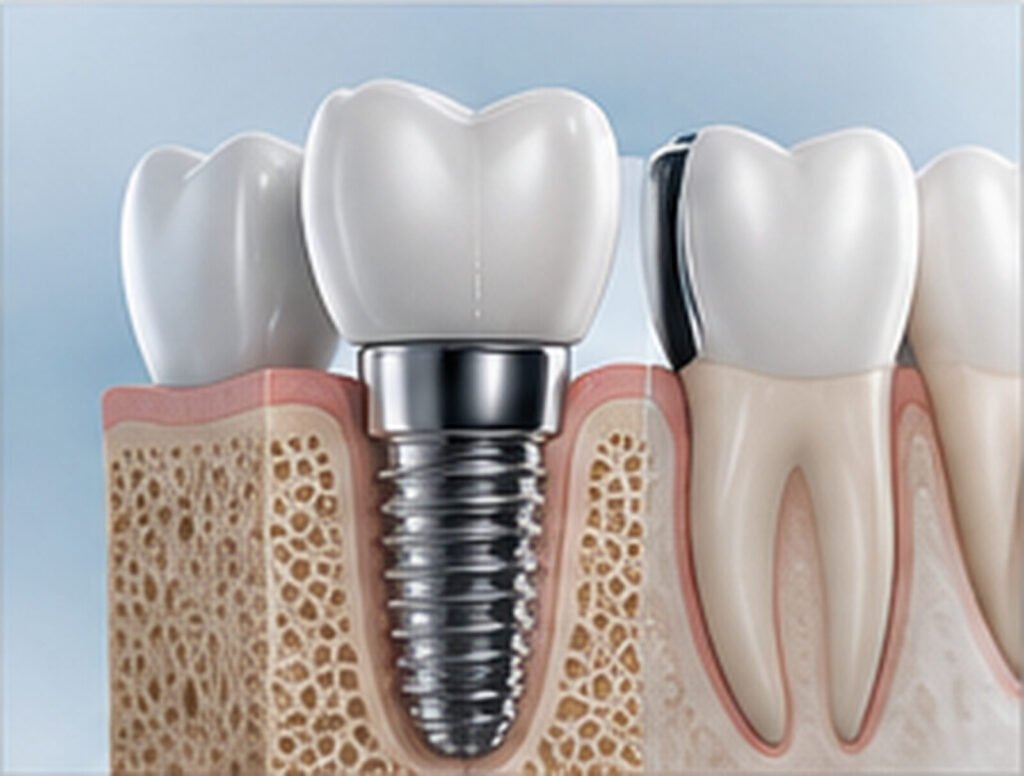
When are implants considered?
Implants are one of the options used to address tooth loss. Suitability is assessed individually for each patient. Common situations include:
- A single missing tooth
- Several missing teeth
- Complete tooth loss
- A wish for more comfort than a removable denture provides
Stages of treatment
Implant treatment usually progresses in several stages:
- Examination, intraoral assessment and, where needed, CBCT (3D) imaging
- Treatment planning based on bone and gum condition
- Placement of the implant into the jawbone
- Healing (osseointegration) period
- Preparation of the restoration (crown/bridge/denture)
How does healing work?
The fusion of the implant with the surrounding bone is called osseointegration. Its duration can vary with the site, bone density and individual healing. The dentist decides whether the restoration can be placed before healing is complete.
Frequently asked questions
Is implant treatment painful?
As the surgical step is performed under local anaesthesia, pain is not expected during the procedure. Mild swelling or tenderness may follow and is managed with the dentist’s advice.
What restorations go on an implant?
A crown for a single tooth, a bridge for several teeth, or a fixed/removable denture for a full arch may be considered.
Does implant longevity depend on care?
Regular oral hygiene and periodic check-ups are important for the health of the implant and surrounding tissues.
What is assessed before implant treatment?
Implant planning looks at far more than the gap itself. The examination assesses the volume and density of the jawbone, gum health, the condition of neighbouring teeth and how the teeth meet. Your medical history, regular medication and smoking habits are also reviewed, since they can influence healing. The findings determine whether an implant is suitable and whether any additional procedure is required first.
- Bone volume and density assessed with imaging
- Any gum disease treated beforehand
- Systemic conditions and medication reviewed
- Clenching or grinding habits noted
Alternatives to dental implants
A missing tooth does not always have to be replaced with an implant. Depending on the condition of the neighbouring teeth, a bridge may be considered; where several teeth are missing, a partial denture; and in complete tooth loss, a removable denture. Each approach has its own advantages and limitations, and the choice is made by weighing the clinical findings together with your expectations.
Frequently asked questions
How soon can the final restoration be placed?
This depends on healing and on the stability achieved at placement. Your dentist decides on the timing after reviewing the site clinically and radiographically.
Does an implant feel different from a natural tooth?
Most people adapt within a short time. Because an implant has no periodontal ligament, sensation when biting can differ slightly from a natural tooth.
For more detail see our dental implants page, and for the period after surgery read dental implant recovery and aftercare. General information is also available from the World Health Organization oral health resources.
This article is for general information only and does not replace an examination, diagnosis or treatment by a dentist.