
Root Canal Treatment
Microscope-assisted root canal treatment, carried out under local anaesthesia to save your tooth.
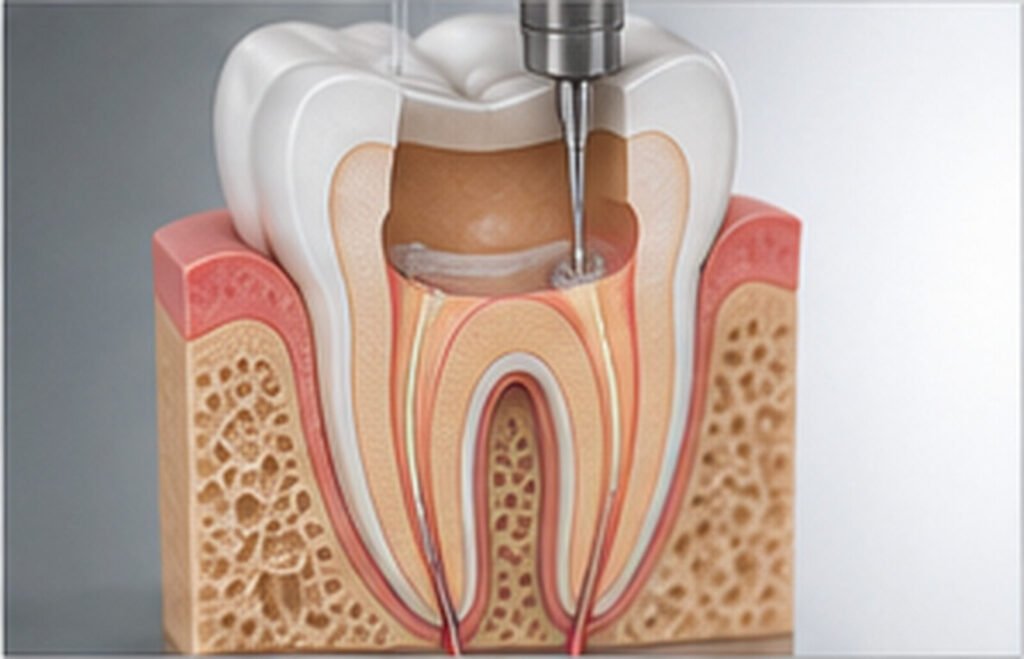
Saving your natural tooth
Root canal (endodontic) treatment removes infected or inflamed tissue from inside the tooth, relieving pain and preserving a tooth that might otherwise need to be extracted.
Comfortable and precise
- Performed under local anaesthesia — virtually painless
- Microscope-assisted for accuracy
- Often completed in one or two visits
- The tooth is then restored, usually with a crown
What to expect
We diagnose with digital imaging, treat gently and give clear aftercare guidance, with written pricing shared before treatment.
Protecting the tooth after root canal treatment
A root-treated tooth can be more prone to fracture because its inner tissue has been removed. For this reason a definitive restoration — a filling or a crown — is usually planned, particularly for posterior teeth with extensive structure loss. The longer a tooth is left without a proper restoration, the higher the risk of fracture and re-infection. Follow-up appointments allow healing to be monitored radiographically.
How many appointments are needed?
Root canal treatment may be completed in one or more visits depending on the number of roots, the extent of infection and canal anatomy. A temporary filling is placed between appointments. If you experience pain or swelling, or the temporary filling comes out, contact the clinic without waiting for your next visit.
During and after the procedure
The procedure is carried out under local anaesthesia, so pain is not expected while it is performed. Mild tenderness on chewing can occur for a few days afterwards, and avoiding hard foods on that side may be advised. Maintaining oral hygiene throughout supports healing.
For general oral health information, see the World Health Organization resources.
Frequently asked questions
Is root canal treatment painful?
It is performed under local anaesthesia, so pain is not expected during treatment. Mild tenderness for a few days afterwards is common.
Will the tooth darken afterwards?
Some teeth change colour over time. Internal bleaching or restorative options can be discussed if this occurs.
Can root canal treatment be repeated?
Where infection persists, retreatment or a surgical approach may be considered. The decision is based on clinical and radiographic assessment.
Are antibiotics always needed?
No. Antibiotics are not required in every case; the decision is made by the dentist based on clinical findings.
How long will the tooth last?
With an appropriate restoration, good hygiene and regular check-ups a root-treated tooth can function for many years. No fixed duration can be guaranteed.
You may also be interested in
Book Root Canal Treatment
Contact us for a free assessment and written treatment plan at our our clinic in Çankaya, Ankara.