
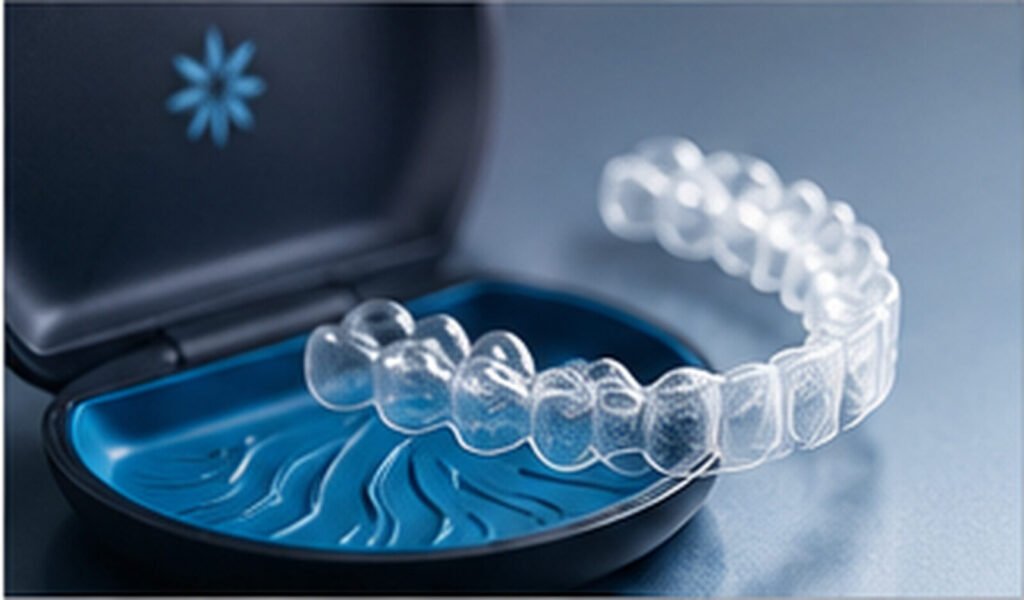
Snoring and mild obstructive sleep apnoea may, in suitable cases, be supported with an oral appliance. These appliances aim to help keep the airway open during sleep by gently positioning the lower jaw. Assessment may require a multidisciplinary approach.
What is an oral appliance?
It is a custom-made, non-surgical option. It may be preferred in suitable patients for comfort and adaptation. The decision on suitability is made by the dentist’s assessment.
Who may it be considered for?
It may come up especially in suitable people with snoring and mild sleep apnoea. In moderate-to-severe conditions, assessment together with sleep medicine may be needed.
The process
It involves assessment, collaboration with relevant specialists where needed, and preparation of a custom appliance. Use and follow-up are planned by the dentist.
Frequently asked questions
Is an appliance suitable for everyone?
Suitability varies by case; the decision is made with assessment and, where needed, a sleep test.
Is it a surgical procedure?
An oral appliance is a non-surgical approach.
Is a sleep test needed?
In some cases a sleep medicine assessment may be requested to confirm the diagnosis.
Is snoring always sleep apnoea?
Snoring on its own does not mean sleep apnoea, though the two can occur together. Excessive daytime sleepiness, morning headaches, frequent waking or witnessed pauses in breathing all point to the need for further assessment. Diagnosis rests on a sleep study (polysomnography) and evaluation by the relevant medical specialties.
- Daytime sleepiness and poor concentration
- Witnessed pauses in breathing
- Morning headache and dry mouth
- Frequent waking during the night
How an oral appliance works
A custom-made appliance aims to hold the lower jaw slightly forward during sleep so that the airway stays more open. Suitability depends on the number of sound teeth, gum health and the condition of the jaw joint. In moderate to severe sleep apnoea, other treatments may take priority.
The dentist’s role
The dentist assesses whether appliance therapy is appropriate for your oral and jaw health, provides the appliance and monitors fit and bite at reviews. Diagnosis and overall management are handled in cooperation with sleep medicine.
Frequently asked questions
Will an appliance stop snoring completely?
Results vary with the individual and the severity of the condition; effectiveness is assessed at review rather than assumed.
Can it be used with missing teeth?
Enough sound teeth are needed for retention. Where teeth are missing, prosthetic options may be considered first.
See our snoring treatment page and read snoring appliance use and care. Further reading: World Health Organization oral health resources.
This article is for general information only and does not replace an examination, diagnosis or treatment by a dentist.